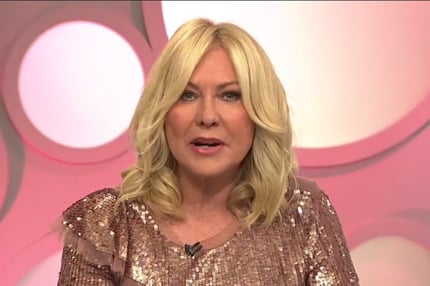
Morning television has a reputation for being typically, well, sedate. But on Monday’s episode ofStudio 10, the panel engaged in a debate that has left people fuming.
It centres around an exchange between daytime television stalwart Kerri-Anne Kennerley and presenter Yumi Stynes regarding protests that took place around the country on January 26, which called for the date of Australia Day to be changed and to highlight ongoing oppression and disadvantages experienced by First Nations people.
Kennerley’s take: “Has any single one of those 5000 people waving the flags, saying how inappropriate the day is, has any one of them been out to the outback where children, babies five-year-old’s are being raped, their mothers are being raped, their sisters are being raped, they get no education? What have you done?”
“You’re sounding quite racist right now.” @yumichild says to Kerri-Anne as they clash over Australia Day & #ChangeTheDate. #Studio10 pic.twitter.com/qI2qBsiT9t
— Studio 10 (@Studio10au) January 27, 2019
To Stynes, the comments sounded “racist”; an accusation that left Kennerley “seriously offended”.
“Just because I have an opinion doesn’t mean I’m racist,” she replied.
But Kennerley’s comments weren’t presented as an opinion – they were presented like fact. So, was she actually right? Let’s take a look.
“Has any single one of those 5000 people waving the flags, saying how inappropriate the day is, has any one of them been out to the outback…?”
Well, yes, actually. Lots of them have.
@marcialangton was in attendance and works with NPY Women, researched on Aboriginal women and violence including our @ANROWS Aboriginal women and DV research and @MerikiKO was in attendance and has worked on FV with Aboriginal women for years. We aren’t single issue people. https://t.co/BHq7EGiQQc
— Prof M Davis [-0-] (@mdavisqlder) January 28, 2019
I helped organise on Saturday and spend the other 85% of my life working to end violence against Aboriginal women but the issues aren’t binary. Aboriginal women ALSO and MORE SO experience the violence of settler colonialism and racism, and racists like KAK make it worse. https://t.co/1B7cGkKx7N
— problematic aunty (@MerikiKO) January 28, 2019
Of course, it should be noted that Kennerley was raising a question rather than making a direct accusation. But it was clearly a loaded one.
Author/filmmaker/actor Elizabeth Wymarra, who was among those to lead a protest against Kennerley outside Channel 10’s Sydney HQ this morning, argued that the premise of Kennerley’s question was not only presumptive and unfounded, but hypocritical.
“There was over 50,000 people that came out and marched in the Invasion Day march in Sydney, and a lot of those people were non-Indigenous people. They were non-Indigenous people who care about the oppression and discrimination of my people,” she stated in a Twitter video. “They’re in solidarity with us, unlike you, so it seems… Last time I checked, I don’t see you coming into my house, or my community, helping my people. So who are you to point fingers at people going to marches?
“You don’t know none of those 50,000 people that marched with us. You don’t know they don’t go to community.”
So somehow all the Indigenous and non-Indigenous people marching about changing the date so ALL Australians can celebrate, are being questioned about whether they’ve been to a remote community or not? And somehow there is a link between marching and sexual assault? https://t.co/wd6Zf3YHZ1
— Dr Anita Heiss (@AnitaHeiss) January 28, 2019
In remote Indigenous communities “…children, babies, five-year-old’s are being raped, their mothers are being raped, their sisters are being raped, they get no education…
Breaking it down…
Sexual abuse.
Stynes’ criticism of this statement was that Kennerley was implying that “women aren’t being raped here in big cities, and children aren’t being raped here in big cities”. In other words, that sexual violence is a remote Indigenous issue rather than a national one.
That’s clearly not the case. Australian Institute of Health and Welfare data indicates that one in five women around Australia have experienced sexual violence since age 15.
There is evidence that Indigenous Australians are more likely to experience sexual violence, though. According to the AIHW, in 2016 the rate of Indigenous sexual assault victims (ie. per 100,000 people) across NSW, Queensland, Northern Territory and South Australia was between 2.3 and 3.4 times higher than that among non-Indigenous victims.
When it comes to sexual violence against children, the picture is similar. In 2016 the rate of Indigenous children, aged 0–14, recorded by police as victims of sexual assault in the above states was approximately twice that of non-Indigenous children.
Importantly though, data on the sexual assault of women and children inremoteIndigenous communities specifically – or “the outback”, as Kennerley put it – is not comprehensive.
Education.
The claim that there’s “no education” in outback communities is quite obviously not true. According to Creative Spirits, there are reportedly 17,000 Indigenous children attending school in remote areas.
That being said, there are barriers to accessing education in particularly remote communities. including availability of teaching staff, transport, weather cutting off roads, etc., which impacts attendance rates and outcomes for Indigenous students. For example, while attendance rates among Indigenous students in inner regional areas stood at 86.8 per cent in the first half of 2017, it dropped to 64.6 per cent in very remote areas according to government data.
But overall, nationwide stats show that the majority of Aboriginal and Torres Strait Islander students attend school and are achieving national minimum standards for literacy and numeracy.
Indigenous university enrolment has also more than doubled over the past decade.
Kerri-Anne’s clarification.
While sexual assault and access to education are real issues for remote Indigenous communities, critics pointed to the reductive, sweeping way she chose to address them.
As Aboriginal women we never stop fighting 4 our kids our freedom&lives. Kerri Anne every one of us at the March fight everyday on a national scale BUT u only chose to see us & speak about us when it benefits u to dehumanize us #studio -10 @DjirraVIC
— Antoinette Braybrook (@BraybrookA) January 28, 2019
Having Kerri-Anne Kennerley be completely racist on national television assuming sexual harm and conduct happens in community is the exact same attitude our government had when they implemented the Emergency response into the NT.This dis course CANNOT be allowed. We know the harm
— Nessa Turnbull Roberts (@IndigenousX) January 28, 2019
Kennerley responded to that the backlash this morning onStudio 10. While again taking issue with being labelled racist, this time she made an important distinction.
She used the word “some”.
“The statement that I made was about the tragic abuse of women and children in some Indigenous communities,” she said. “Now that is a fact, it’s backed up by a lot of people. It is not a judgement, it doesn’t mean.. thinking a group is superior, or someone is inferior.”
Belinda Jepsen
Author
No Comments
Be the first to leave a comment